
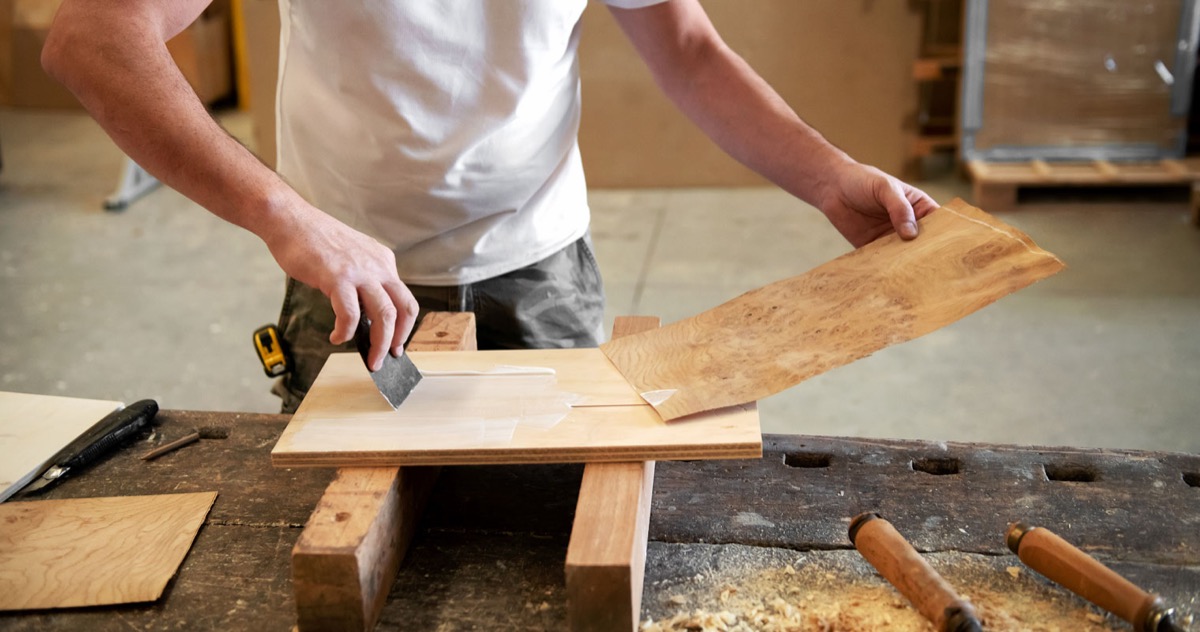
There is no single best glue for wood veneer. The right pick depends on how you plan to apply the veneer, whether it is raw or paper backed, and how flat and heat proof the result has to be. Below we compare the real options, honestly, then give you a clear recommendation table.
How to choose a veneer glue
Four questions settle it. First, how are you pressing? A vacuum bag or a caul and clamp press lets you use rigid glues that need even pressure. No press means contact cement, peel and stick, or the iron on method. Second, is your veneer raw or paper backed? Thin raw veneer bleeds glue through the face far more easily. Third, does the finished part live near heat, a window, or a heat vent? Some glues soften and bubble when warm. Fourth, do you ever need to undo the work? Only hide glue is truly reversible.
PVA and cold press glue, the everyday choice
Standard yellow wood glue and dedicated cold press veneer adhesives are both PVA, a water based glue. For veneering, a cold press formula such as Better Bond or a quality Titebond beats ordinary yellow glue: it has higher solids and a more rigid, harder set, which cuts the risk of veneer creep, where a soft glue line lets the veneer slide and telegraph over time.
PVA is cheap, safe, cleans up with water, and gives a strong, long lasting bond. The catch is that it needs firm, even pressure while it cures, so it wants a vacuum press or a well clamped caul and platen setup.
Contact cement for wood veneer
Contact cement is the go to when you cannot clamp: curved parts, edge banding, columns, and quick jobs. You coat both the substrate and the veneer, let both faces dry to the touch, then press them together for an instant grab, no clamps required.
That convenience comes with real trade offs. Contact cement stays slightly flexible after it cures, so a part exposed to high heat can bubble. Worse, it bleeds through thin raw veneer, and penetrating finishes can seep down and attack the glue. Because the grab is instant, you get one shot at placement, so use slip sheets to line the veneer up before contact.
Urea-formaldehyde, the flattest, most heat-proof result
For the flattest, most durable, most heat proof result, urea-formaldehyde resin, sold to woodworkers as Unibond 800, is the pro standard. It cures to a hard, rigid glue line that resists moisture and heat and holds veneer dead flat for decades.
The cost is handling. UF must be mixed, has a limited pot life, needs a warm shop to cure properly, and demands a press. Work with ventilation and gloves while it is wet.
Hide glue, hammer veneering and repairs
Hide glue is the traditional choice, and it still earns its place. Hot hide glue is what makes hammer veneering possible: you brush it on, lay the veneer, and work a veneer hammer across the surface to squeeze out glue and air, no press or vacuum bag needed.
Its great virtues are that it is reversible, so repairs and antique restoration are possible, and that it is transparent to stains and finishes. The downsides: you have to heat and prepare it, and it has little water resistance.
3M PSA peel and stick
Peel and stick veneer comes pre coated with a 3M pressure sensitive adhesive. You peel the backing and press the veneer down, no glue, no clamps, no cure time. For it to hold, you must apply a lot of pressure, a veneer scraper or hammer worked hard with the grain. The trade off: it is not reversible, and it is only sold as paper backed veneer.
Recommendation table
| Your situation | Best glue |
|---|---|
| Flat panel, you have a press | Cold press PVA |
| Heirloom or architectural panel | Urea-formaldehyde |
| Curved part or edge, no clamps | Contact cement |
| Fastest, no press, beginner | 3M PSA peel and stick |
| Hammer veneering or repair | Hot hide glue |
Practical steps for a clean glue-up
- Flatten and de-dust the substrate. Any bump or crumb telegraphs through the veneer.
- Flatten buckled raw veneer first so it lies flat before glue-up.
- Cut the veneer slightly oversize and dry-fit before you commit any glue.
- Spread glue evenly on the substrate. Thin and even beats thick and blotchy.
- Press with even force, working from the center out to chase air toward the edges.
- Let PVA and UF cure fully before you trim, ideally overnight in a warm shop.
- Trim the overhang with a sharp knife, then sand lightly and finish.
Shop veneer to practice on
Grab a small sheet or a craft pack to test your glue-up before you commit to a big panel.
Frequently asked
What is the best glue for wood veneer?
For most flat panel work with a press, a cold press PVA such as Better Bond or Titebond is the best all round choice. For the flattest, most heat proof heirloom panels, use urea-formaldehyde. Without a press, reach for contact cement, hide glue, or peel and stick.
Can you use contact cement for wood veneer?
Yes, and it is ideal for curves and edges where you cannot clamp. But it bleeds through thin raw veneer and can bubble under heat, so use paper backed veneer and keep it away from hot spots.
Will veneer glue bleed through the face?
It can, especially with thin raw veneer and water based glues. Paper backed veneer resists bleed through, and spreading glue thinly and evenly helps.
Which veneer glue is the most heat resistant?
Urea-formaldehyde cures to a rigid, heat resistant glue line and is the top choice for parts that get warm. Contact cement is the least heat resistant.
Is hide glue better than PVA for veneer?
It depends on the job. Hide glue is reversible and invisible under finish. PVA is stronger against water and easier for a beginner. Pick hide glue for reversibility, PVA for everyday flat work.
Ready to start a project?
Browse the species library, then grab live sheets from our eBay store.